

MyRockabye – A Trusted Baby Product Marketplace, Built to Grow
MyRockabye began with a mother who noticed a gap. Parents across the UK were hunting for well-made baby products across dozens of small independent shops, with no single place that gathered those makers under one trusted roof.
The brief was to build that place: a marketplace where independent sellers could reach families directly, and where parents could shop a curated range with confidence. What started in 2019 became a relationship that carried through a full platform refresh in 2021.
Key Information:
| CMS Used | WordPress | ||||||
| Category | Multi-vendor Marketplace | ||||||
| Ecommerce Platform | WooCommerce | ||||||
| Server setup | Litespeed on DigitalOcean cloud server | ||||||
| Theme | Premium theme | ||||||
| Experiences | Responsive, Speed Optimized | ||||||
| Features Included |
|
||||||
| Plugin Integrations |
|
||||||
| Service Integrations |
|
||||||
| Security |
|
||||||
| Payment Gateways |
|
||||||
| Optimizations |
|
||||||
| Skills |
|
||||||
| Rated by Client |
Project Overview
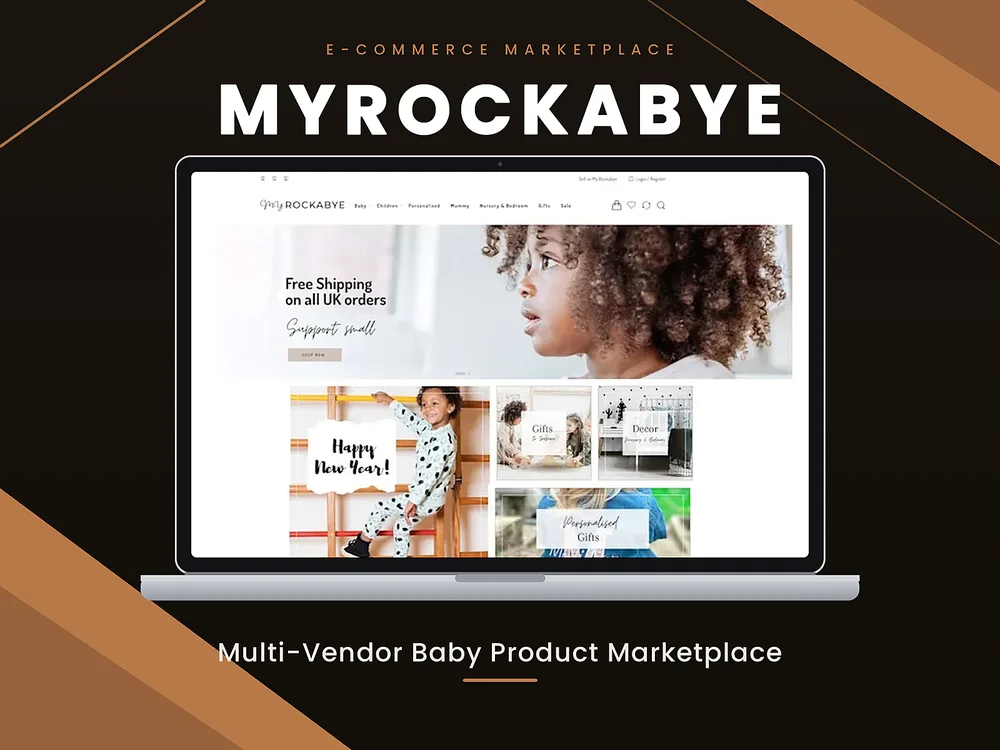
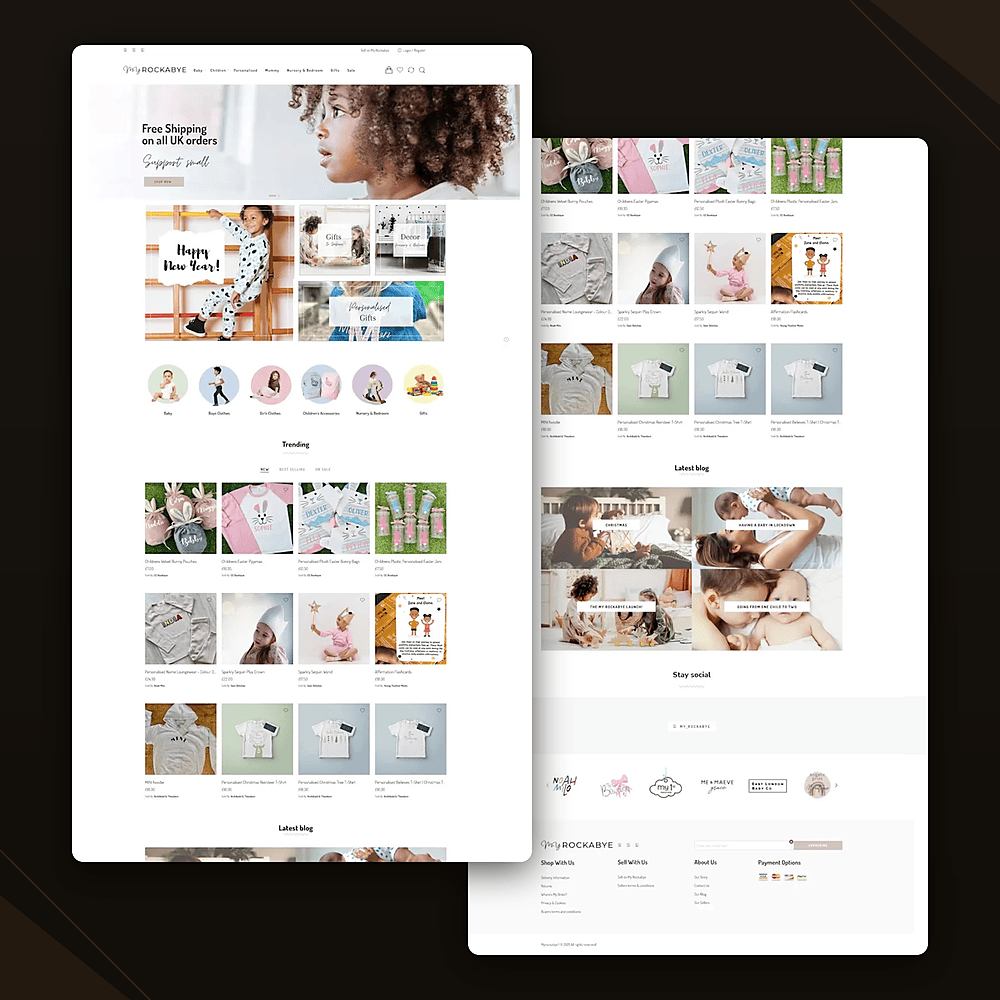
MyRockabye is a multi-vendor marketplace for baby and children’s products. Rather than sourcing and warehousing stock, the business hosts independent sellers, each running a small storefront inside a shared shopping experience covering baby essentials, children’s clothing, personalised gifts, nursery décor, and products for mums.
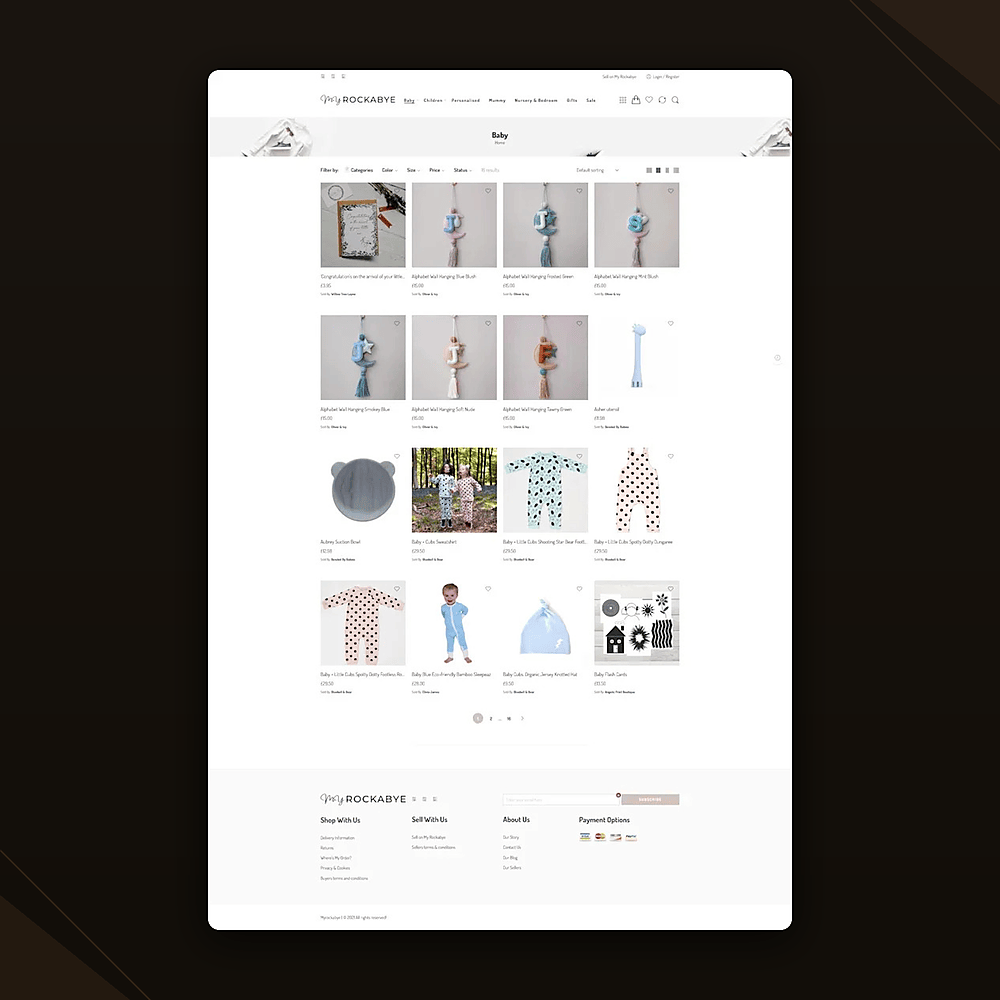
For parents, the value is straightforward. They browse one catalogue, checkout once, and reach makers they might never have found on their own, from alphabet wall hangings and organic sleepwear to teething rings and flash cards. Every product carries a visible “Sold by” credit, so shoppers always know which small business they are supporting.
For vendors, MyRockabye removes the hardest part of selling online. A maker with a beautiful product but no ecommerce infrastructure gets a storefront, a checkout, order handling, and an audience, without standing up a website of their own. The marketplace handles discovery and payments; the seller focuses on the craft.
Business Goals
The founder’s ambition was never a shop. It was a platform that could hold many businesses at once and grow as more sellers joined.
That shaped every priority. The site needed to feel trustworthy enough that parents would spend on it and reliable enough that vendors would stake their reputation on it. It had to make a catalogue built by many different sellers feel like one coherent store. And it had to run lean, because a marketplace only works when day-to-day operations don’t depend on the owner touching every order.
Above all, the platform needed room to scale. The 2019 build had to support a business that didn’t fully exist yet, and the 2021 refresh had to carry one that had found its footing.
Challenges
A marketplace is a harder problem than a shop, because you are designing for three parties at once: the customer, the vendor, and the business owner sitting between them.
The first challenge was coherence. When products come from many independent sellers with different photography and naming habits, a catalogue can quickly feel like a jumble. The store had to absorb that variety and still present a single, calm shopping experience.
The second was discovery. A growing multi-vendor catalogue gets harder to navigate with every new listing. Parents rarely arrive knowing a seller’s name; they arrive knowing they want a sleepsuit, in a colour, at a price. The site had to let them narrow down fast.
The third was trust. Parents spending on products for their children are a demanding audience, and rightly so. Every signal, from shipping clarity to secure payment to knowing who they’re buying from, had to reduce hesitation at the point of purchase.
The fourth was operational load. Onboarding sellers, managing products, handling vendor questions, and processing payouts can bury a small team. The platform had to hand as much of that as possible to the vendors themselves, safely.
Design & Development
The work began with the shape of the catalogue rather than the look of it. Before any theme decisions, the priority was mapping how a many-seller inventory would be organised, filtered, and browsed, because that structure is what a marketplace lives or dies on.
WordPress and WooCommerce formed the foundation. WooCommerce is a mature, well-supported ecommerce engine, which matters for a business that intends to run for years rather than months, and WordPress gave the founder a familiar way to manage content like the blog and category pages without developer help.
The marketplace layer came from Dokan, extended to fit MyRockabye’s specific needs. Dokan turns a single-store WooCommerce site into a multi-vendor platform, giving each seller their own dashboard, product controls, and order visibility. Choosing an established marketplace framework over a custom build was a deliberate call: it meant vendor management, commissions, and payouts were handled by proven code, freeing the budget for the customisation that actually differentiated the store.
A premium theme was chosen as the starting point and then reworked heavily. Buying a strong foundation and customising it, rather than building every component from scratch, is what let a business of this size get a polished, marketplace-grade storefront within a sensible budget and timeline. ACF Pro was used to give the client structured, editable content areas, so the homepage and product presentation could evolve without touching code.
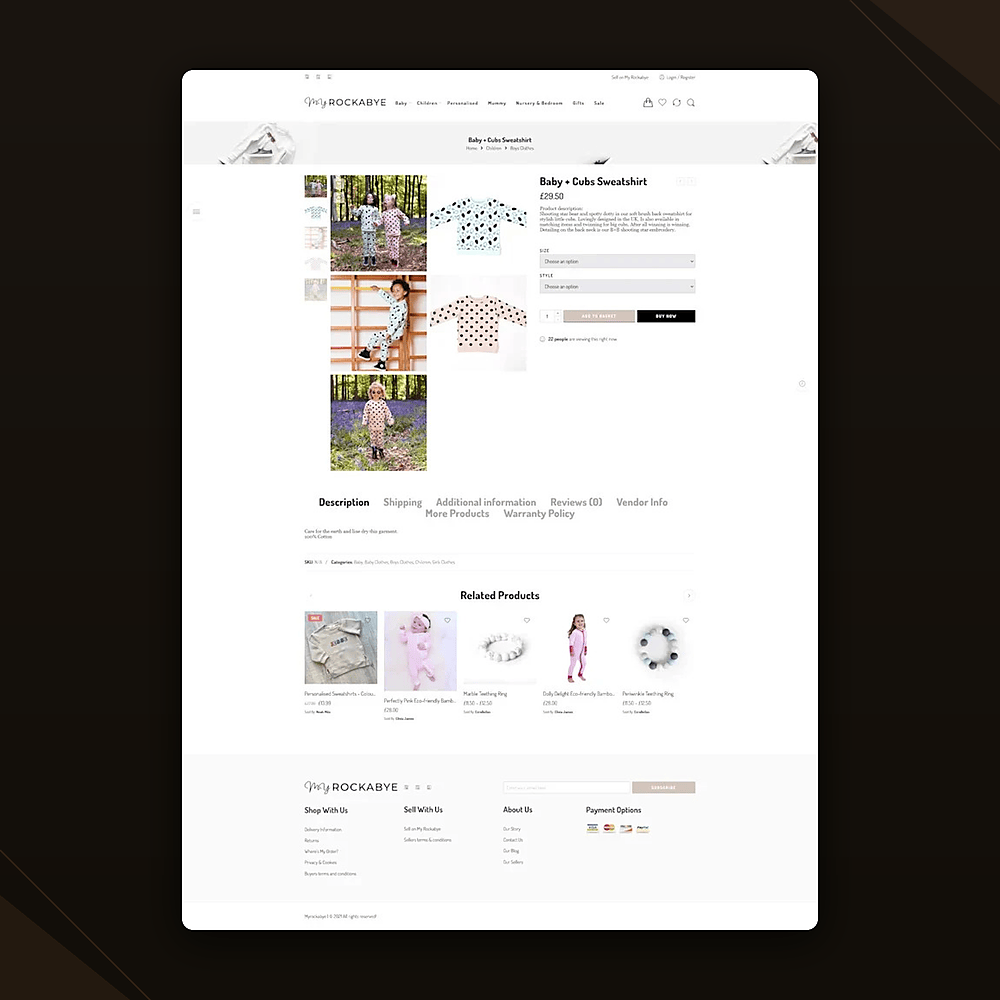
The product page shows where that customisation earned its keep. Each listing carries a full image gallery, clear variation controls for size and style, a description split into logical tabs, and a dedicated Vendor Info section, so the seller behind the product is never hidden. The layout does the quiet work of making a third-party product feel as considered as a first-party one.
Everything was built mobile-first. Parents shop in the margins of the day, one-handed, often with a child on the other arm. The category grid, filters, and checkout were all designed to hold up on a phone, because that is where most of this audience actually browses.
Marketplace Experience
The heart of the project is what happens after a vendor signs up. A seller gets their own dashboard where they can list products, set variations and pricing, track orders, and manage their storefront independently. This self-service model is the only way a marketplace scales, because it means growth in sellers doesn’t translate into growth in the owner’s workload.
For products themselves, the vendor controls their own listings end to end, while the store enforces a consistent presentation so nothing a seller uploads breaks the shared experience. That balance, giving vendors freedom while protecting the customer’s view, is the core design tension of any marketplace, and it was resolved in MyRockabye’s favour by leaning on structured layouts rather than free-form entry.
On the customer side, the shopping experience stays deliberately unified. Products from different sellers sit side by side in the same grid, share the same card design, and route through the same basket and checkout. A shopper can fill a single order from several vendors and never feel the seams. The “Sold by” credit on every product does double duty here: it’s honest about who the maker is, and it quietly reinforces the community-of-small-businesses story that gives the marketplace its character.
Key Features
The features on MyRockabye aren’t a checklist; they’re a system for reducing friction on both sides of the marketplace.
Advanced filtering is the engine of product discovery. Category, colour, size, and price filters let a parent cut a broad, multi-vendor catalogue down to the handful of items they actually want, in seconds. As the number of sellers grows, this is what keeps the store shoppable rather than overwhelming.
One-to-one messaging and a support desk address the trust gap that’s unique to marketplaces. When a product comes from an independent seller, buyers naturally have questions, and a direct line between customer and vendor turns hesitation into a sale. The support desk gives the business a structured way to handle issues before they become complaints, which is exactly the kind of care a parent-focused brand needs to show.
The payment experience was built for choice and reassurance. Card payments, PayPal, and Stripe, including Stripe Connect and WooPayments, cover how different customers prefer to pay while handling the harder marketplace problem underneath: routing money to the right vendor. Stripe Connect in particular lets funds flow to individual sellers cleanly, which is what makes a many-vendor payout model workable rather than a monthly accounting headache.
Analytics tie it together, giving the business visibility into how customers move through the store, what they browse, and where they drop off, so decisions about the catalogue and layout can be made on evidence rather than instinct.
None of these features stands alone. Filtering feeds discovery, messaging and support build the confidence to buy, flexible payments close the sale, and analytics inform what to improve next.
Performance & Optimization
Speed is not a vanity metric for this audience. A parent shopping on a phone during a five-minute break will abandon a slow page without a second thought, and every extra second of load time is a chance to lose the sale.
The site runs on a LiteSpeed stack hosted on DigitalOcean, with Cloudflare sitting in front. That combination handles caching, content delivery, and traffic efficiently, so pages stay fast even as the catalogue and visitor numbers grow, an image-heavy marketplace being exactly the kind of site that punishes a weak hosting setup.
The results held up across the standard benchmarks: Google PageSpeed above 90, GTmetrix above 85%, and Pingdom above 95%. Those scores matter less as numbers than as evidence that the store stays quick under the weight of a real, growing product catalogue.
Security
For an ecommerce site handling family purchases and card details, security isn’t a feature to bolt on; it’s a precondition for trust.
Cloudflare provides a first line of defence at the edge, filtering malicious traffic before it ever reaches the site. An SSL certificate encrypts every transaction, so payment and account details are protected in transit, and its presence is also a visible reassurance to shoppers. Wordfence and WP Hardened protect the WordPress layer itself against the common attacks that target the platform, while a server firewall guards the infrastructure beneath. Google reCAPTCHA keeps spam and automated abuse away from forms and vendor sign-ups.
Layered this way, security does its most important job invisibly: it protects both the customers who buy and the vendors who trust the platform with their business, without ever getting in the way of a sale.
Technology Stack
The stack was chosen for longevity and fit rather than novelty. WordPress and WooCommerce give a non-technical founder a manageable, well-supported ecommerce foundation; Dokan adds proven multi-vendor infrastructure so vendor management didn’t have to be reinvented; ACF Pro makes the content flexible and editable; and a heavily customised premium theme delivers a marketplace-grade storefront without the cost of building every element from zero. Together they let the budget go where it mattered, into the marketplace experience, while keeping the platform something the client could actually run and grow.
Outcome
MyRockabye launched in 2019 as a working marketplace: a place where independent sellers could open a storefront and parents could shop them all in one basket. The business found its audience, and the platform did its job of carrying many small sellers under one trusted name.
That success is what led to the 2021 refresh. As the market shifted and the business matured, the platform was modernised to keep pace, tightening the storefront, updating the experience, and making sure the foundation could support where the business was heading next. Returning to refresh a site two years after building it is the clearest signal a project worked: the client came back because the first partnership earned it.
Across both phases, the work was delivered quickly and ahead of schedule, with the kind of ongoing communication that turns a one-off build into a long-term working relationship.
Client review for this project
MS has been a pleasure to work with. His communication has been fantastic, his knowledge and recommendations have been excellent and he has gone over and above for me order sorting issues I was not aware of. He delivered very quickly and ahead of schedule. His knowledge of Marketplace ecommerce website including Woo Commerce and Dokan is excellent, I will certainly be using again very soon. One very very happy customer.