
Magnus Pharmaceuticals – Catalogue, Verification and Trust by Design
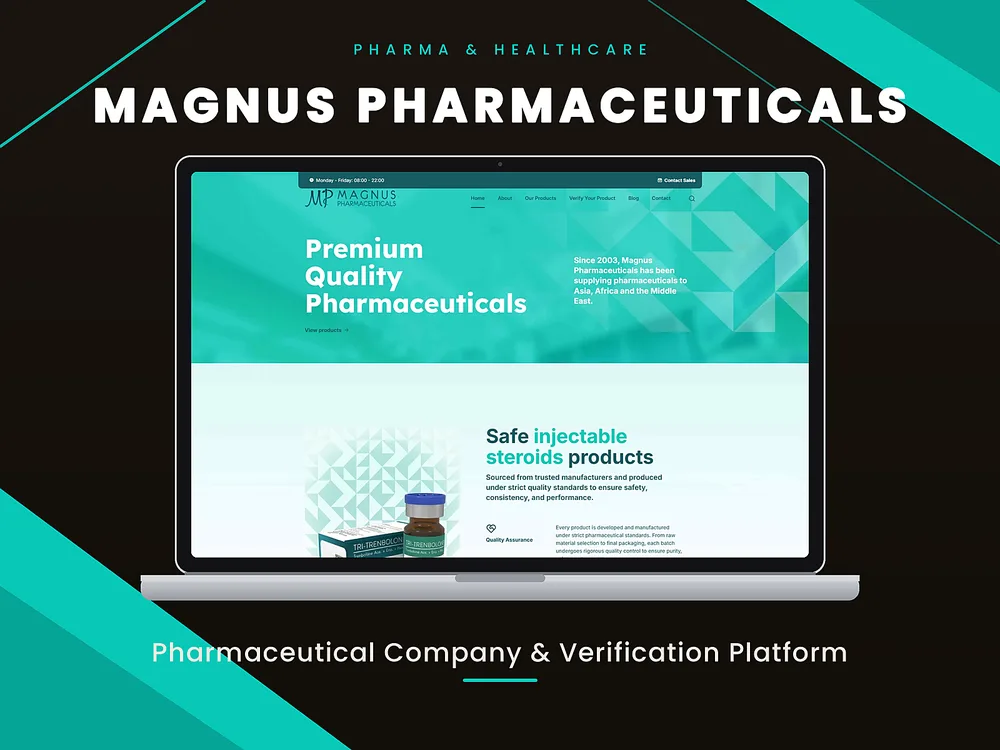

Magnus Pharmaceuticals has supplied medicines across Asia, Africa and the Middle East since 2003, with distribution now reaching more than thirty-five countries. The company needed a website that carried the same weight as its manufacturing standards.
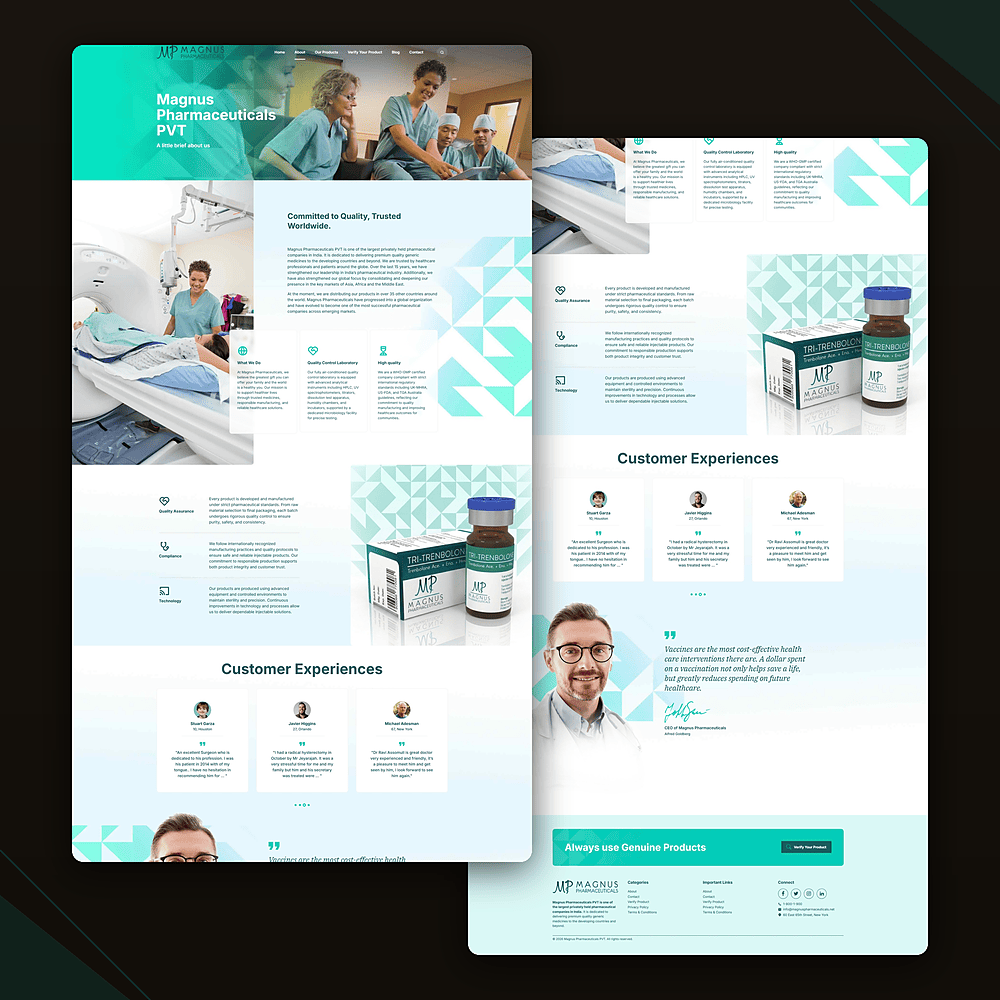
We rebuilt Magnus on WordPress, using WooCommerce as a catalogue engine rather than a shop, and paired it with an on-site authenticity check. The result is a range that buyers can study with the depth they expect and a way to confirm a product is genuine before it is ever opened.
Key Information:
| CMS Used | WordPress | ||||||
| Category | B2B Catalog | ||||||
| Ecommerce Platform | WooCommerce | ||||||
| Server setup | Apache & Nginx on Cloudways DigitalOcean. | ||||||
| Theme | Premium theme | ||||||
| Experiences | Responsive, Speed Optimized, Retina Ready | ||||||
| Features Included |
|
||||||
| Plugin Integrations |
|
||||||
| Service Integrations |
|
||||||
| Security |
|
||||||
| Optimizations |
|
||||||
| Skills |
|
||||||
| Rated by Client |
Project Overview
Magnus Pharmaceuticals is a privately held manufacturer producing injectables, oral tablets, fat burners and post-cycle therapy products under strict quality control. Its buyers are not casual shoppers. They are distributors, clinicians and informed customers who weigh sourcing, purity and provenance before they commit.
The website carries most of that decision. A visitor arrives already cautious, because the category is one where counterfeits circulate freely and a wrong product carries real consequences. So the site has to do two jobs at once: present the range with the clarity a technical buyer expects, and give that same buyer a way to prove what they are holding is authentic.
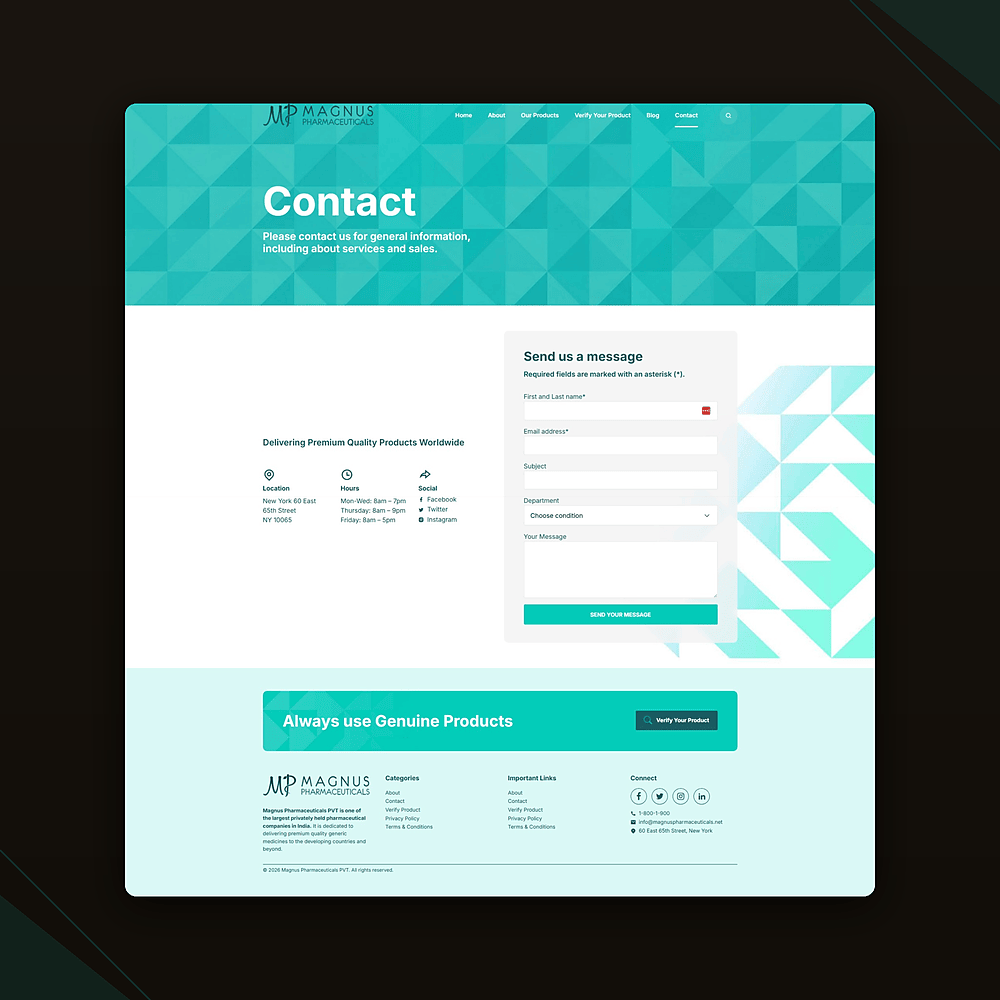
This is a business-to-business operation, not a consumer store. The site presents the range and opens a conversation with sales — the header leads with Contact Sales, not a shopping cart — because buyers in this trade are qualified and dealt with directly, never checked out anonymously. So we treated the website as the company’s front line rather than a brochure or a shop. It is where reputation is either earned or lost in the first few minutes.
Business Goals
The brief came down to trust, and everything else served it.
Buyers had to be able to read a product the way a specialist reads a datasheet. That meant surfacing chemical detail, handling requirements and compliance notes without burying the person who simply wants the price and what the product does. Information needed a hierarchy, not a dump.
The catalogue had to feel considered. A manufacturer that presents its range carelessly invites doubt about how carefully it makes the range. Consistent product presentation is a quiet signal that the operation behind it is disciplined.
And the company needed a credible answer to the one question that shadows this entire sector: how do I know this is real? Answering it on the company’s own domain, quickly and without friction, was the difference between a site that reassures and one that leaves the doubt in place.
Challenges
Counterfeiting sits at the centre of the pharmaceutical trade, and it shaped nearly every decision. A buyer who cannot distinguish a genuine unit from a copy will hesitate, and hesitation in this market usually ends the sale. The site had to remove that hesitation, not with claims, but with a mechanism.
The catalogue added its own complexity. Twenty-seven products spread across four working categories, each carrying a dense layer of technical data — chemical names, formulas, CAS numbers, half-life, detection windows, documented benefits and risks. Presenting that depth on every product without turning each page into a wall of text was a genuine information-architecture problem, not a styling one.
Performance mattered more than it first appears. Buyers in emerging markets often browse on mobile connections that punish heavy pages. A slow catalogue does not just frustrate; it reads as amateur, and amateur is fatal when the product is medicine.
Security was non-negotiable. The site handles enquiry and customer data, and hosts the verification tool the brand’s credibility now leans on, in a sector that attracts fraud and scrutiny in equal measure. A breach here damages more than uptime — it damages the credibility the whole business rests on.
Design & Development
We started with structure, because a catalogue this technical fails on organisation long before it fails on aesthetics. Before touching design, we mapped how a distributor, a clinician and a curious customer would each move through the same pages, and built the hierarchy around those paths.
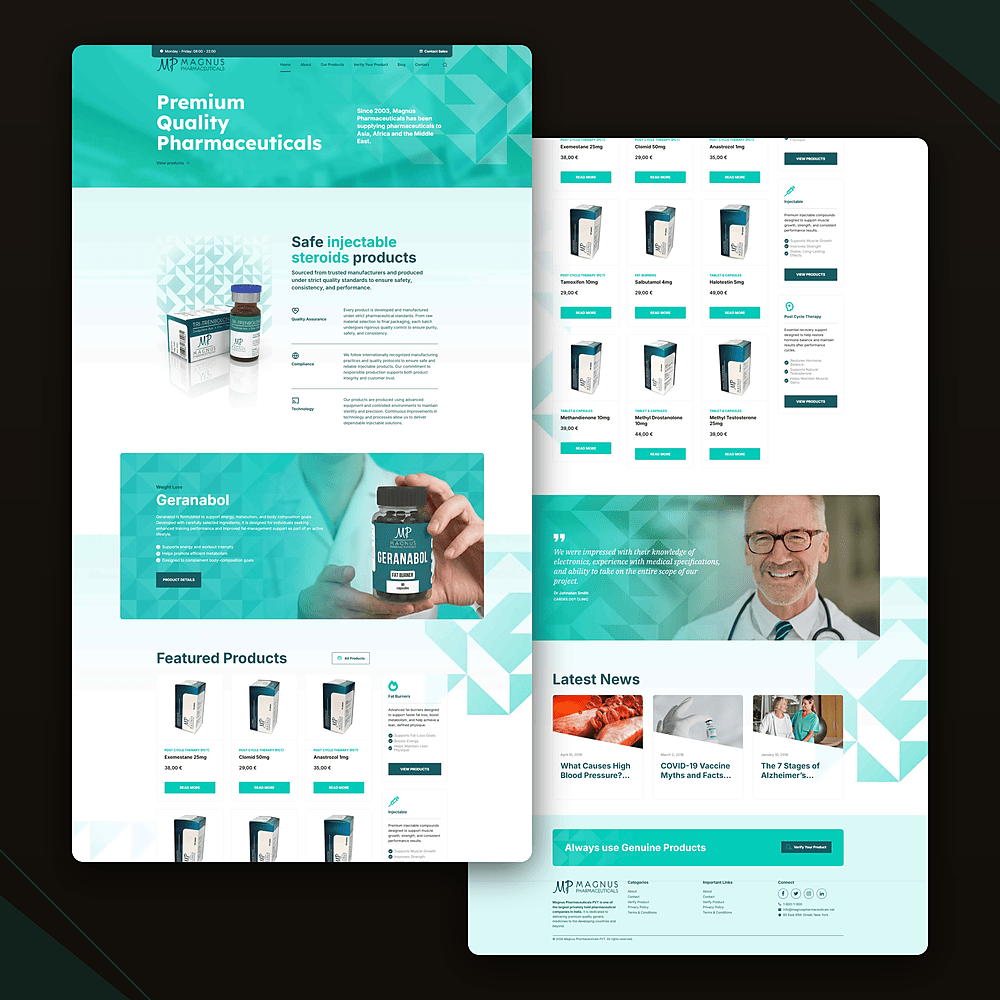
WordPress was the natural base. The Magnus team needed to add products, edit specifications and publish updates without a developer standing by, and WordPress gives them that control while keeping the front end fast and stable. WooCommerce handled the catalogue layer — product types, categories, reference pricing in euros and consistent product pages — with room to grow the range without re-engineering anything.
Because Magnus does not sell through the site, we pared WooCommerce back to the part that earned its place. The cart, checkout and transactional flow were removed, leaving the listing and catalogue structure intact. That was a deliberate call: a business-to-business manufacturer has no reason to expose an anonymous checkout, and stripping it out removed a whole surface of complexity, maintenance and risk while keeping the one thing WooCommerce does better than a hand-built catalogue — organised, filterable, extensible product management.
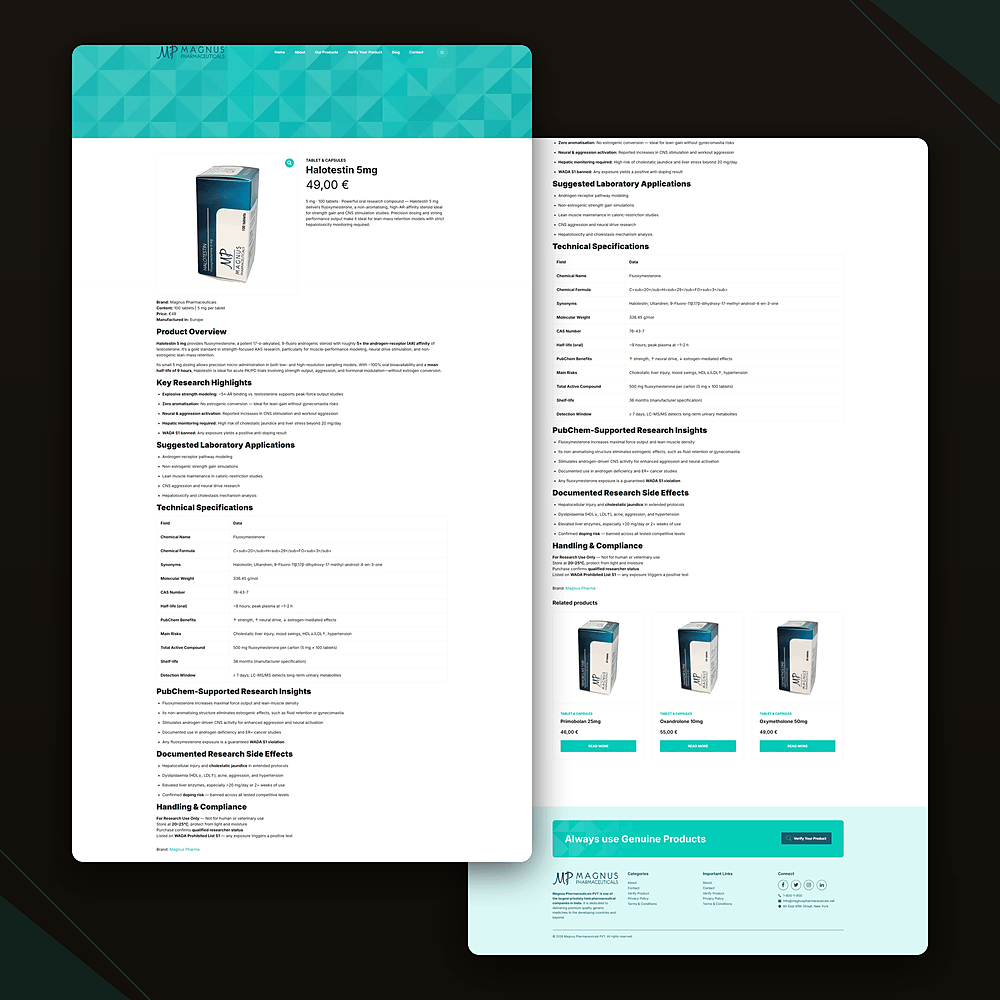
A premium theme gave us a refined starting point, but the real work was in the customisation. We used Advanced Custom Fields Pro to build the deep, repeatable structure each product needed. Rather than forcing staff to hand-format long technical descriptions, we gave every product a consistent set of fields — overview, research highlights, a specifications table, handling and compliance notes. Enter the data once, and every page renders in the same disciplined layout. That consistency is what makes the catalogue read as authoritative, and it is what keeps it maintainable as products are added over the years.
The build was responsive from the first breakpoint outward. Given how much of the audience buys on a phone, the mobile experience was treated as the primary experience, not an afterthought squeezed in at the end.
Product Experience
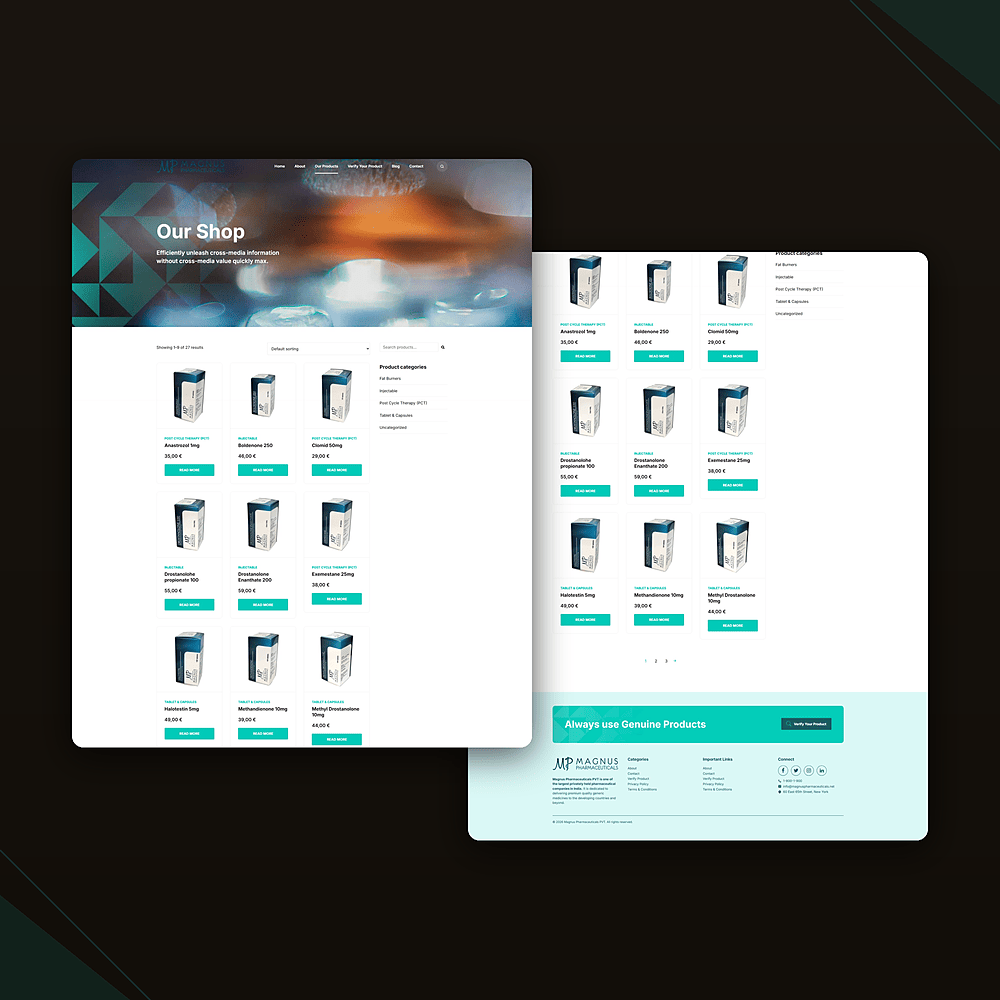
Browsing was designed to let people self-select quickly. The shop groups products into Fat Burners, Injectable, Post Cycle Therapy and Tablet & Capsules, with search and sorting alongside, so a buyer who knows what they want reaches it in a click and a buyer who is exploring can move by category. Each card shows the essentials — category, name, price — and nothing that gets in the way.
The product pages are where the strategy shows. Each one opens with a plain summary of what the product is and who it is for, then layers in the technical depth a serious buyer needs: a research overview, key highlights, a full specifications table, documented benefits and risks, and handling and compliance guidance. The order matters. A customer gets their answer in the first two lines; a specialist keeps reading and finds the CAS number, the molecular weight and the shelf life. One page serves both without compromise.
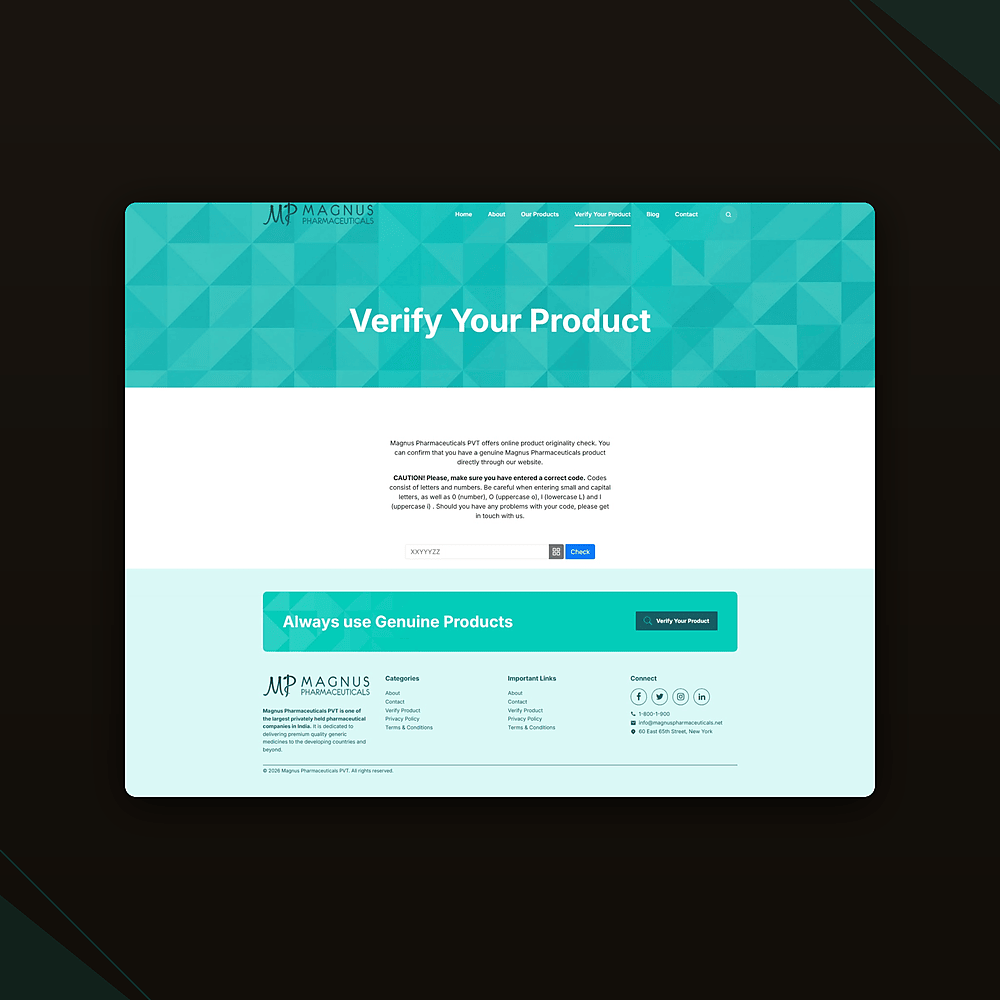
Then there is verification, the feature that anchors the whole site. Every genuine Magnus product carries a unique code, and the Verify Your Product page lets anyone enter that code — or scan it — and confirm the item on the manufacturer’s own domain in seconds. The page even coaches the user through the characters people most often mistype, the 0 and O, the l and I, because a verification tool that returns false negatives would undermine the very trust it exists to build.
We delivered this with an established, actively maintained serial-code plugin rather than a bespoke module, and that choice was itself a piece of engineering judgement. A verification system is only as valuable as it is reliable over time; a well-supported plugin brings unique code generation, defined code patterns, QR scanning and one-time-check controls that are hardened and updated by its maintainers, where a custom build would have become the client’s problem to patch for years. Our work was in selecting the right tool, configuring the code format and lists around Magnus’s products, and shaping the front end so the check feels native to the site. It is a decision that favours long-term maintainability over the appearance of custom cleverness.
The workflow answers the sector’s hardest question directly. Unique product codes give a manufacturer a scalable way to identify and authenticate individual units at volume, and on-site validation turns that system into something a customer can actually use. When a buyer can confirm their product is genuine before opening it, counterfeits lose their cover and the brand becomes the reference point for authenticity — exactly where a pharmaceutical company wants to stand.
Key Features
The features were never meant to stand alone; they reinforce each other. The catalogue presents the range with consistency, the ACF-driven product pages give that range technical credibility, and the verification system closes the loop by letting buyers confirm what the catalogue promised. Code generation and on-site validation are two halves of one idea — a way to identify each unit at scale, and a way for the customer to check it — delivered through a proven serial-code plugin so the system stays supported and current without ongoing custom maintenance.
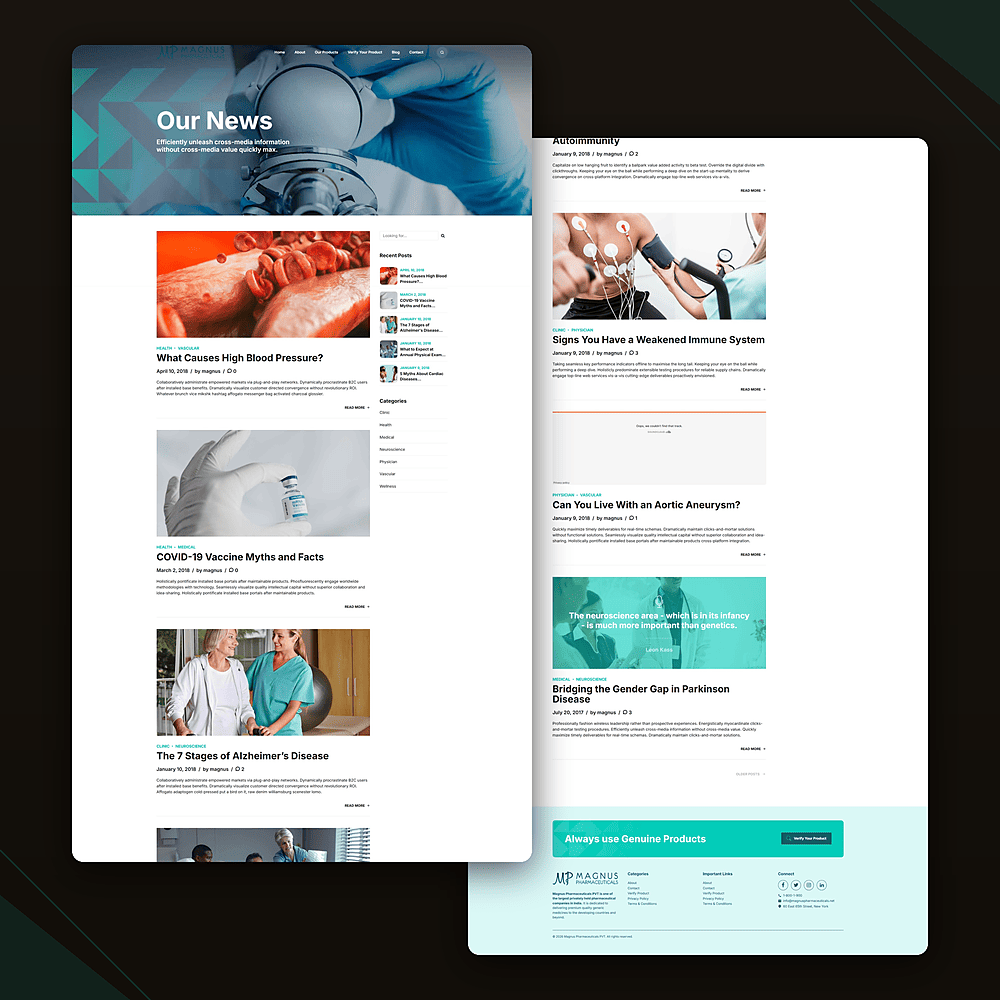
Analytics runs underneath all of it. With Google Analytics in place, Magnus can see which products draw attention, where visitors enter and leave, and how the verification page is used — the kind of insight that turns guesswork about customer behaviour into decisions grounded in evidence. Responsive design ties the set together, making sure every one of these capabilities works as well on a phone as on a desktop, because that is where much of the audience actually is.
Performance & Optimization
The site runs on Apache and Nginx together on Cloudways, hosted on DigitalOcean infrastructure. That pairing was deliberate: Nginx serves static content quickly and efficiently while Apache handles the dynamic WordPress and WooCommerce logic, and Cloudways keeps the stack managed and stable without the overhead of hand-tuning a raw server. For a catalogue that will keep growing, headroom and reliability were worth more than a cheaper, more fragile setup.
We optimised the front end against the benchmarks buyers feel even when they never name them — load speed, responsiveness, stability under a slow connection. The site scores 90+ on Google PageSpeed Insights, 85%+ on GTmetrix and 95%+ on Pingdom. Those numbers matter less as trophies than as proof the pages open fast for a distributor comparing suppliers on a mobile network, where a few seconds of delay is often the whole decision.
Security
A pharmaceutical brand whose whole promise is authenticity cannot afford a compromised website, so the protection was layered rather than bolted on.
Cloudflare sits in front of the site, filtering malicious traffic and absorbing the automated attacks any pharmaceutical domain attracts. An SSL certificate encrypts everything a visitor submits, from an enquiry through the contact form to the verification code they type in. Wordfence guards the WordPress layer against intrusion and known exploits, a server-level firewall hardens the infrastructure beneath it, and WP Hardened closes the common configuration gaps attackers probe first. hCaptcha keeps bots and spam off the forms and the verification tool without pushing friction onto real users.
The reason for all of it is singular. The site is the place customers go to prove a product is real; if that site were defaced, hijacked or made to serve false results, the damage would fall on the exact trust the brand is built on — something far harder to rebuild than a server. Security here is not an IT line item. It is part of the product.
Technology Stack
The stack was chosen to match the business rather than to chase trends. WordPress and WooCommerce give the Magnus team day-to-day control over a growing catalogue, with WooCommerce reduced to the listing and product-management role the business actually needs; ACF Pro turns dense pharmaceutical data into a consistent, repeatable structure that stays maintainable as products are added; an established serial-code plugin runs verification so that critical feature stays supported and updated without bespoke upkeep; a managed Apache-plus-Nginx environment on Cloudways and DigitalOcean keeps the site fast and stable; and a security layer of Cloudflare, Wordfence, SSL, hCaptcha and server hardening protects the data and the trust the business depends on. Built on PHP, HTML5, CSS3, JavaScript and jQuery, it is a set of well-understood, well-supported technologies — the right call for a company that needs this site to run dependably for years, not to impress for a quarter.
Outcome
Magnus Pharmaceuticals now has a website that reflects the standards of the company behind it. The catalogue presents a technical range clearly enough for specialists and simply enough for everyone else. The verification workflow gives customers a direct way to confirm authenticity, turning the sector’s central anxiety into a point of confidence. And the whole thing sits on a managed, secured, well-optimised foundation built to scale as the product range and the markets grow.
Just as important, the site is maintainable. The Magnus team can add products, update specifications and publish content without re-engineering anything, because the structure was designed for that from the start. The work was built to last, not just to launch — and the client’s response reflected it.
Client review for this project
A highly talented programmer with a professional approach. The whole Team of Magnus Pharmaceuticals is satisfied with the cooperation. Very creative and understanding approach, above-standard solutions. We wish MS all the best. We recommend cooperation.