
Inquire Talk: Building a Therapist Marketplace From the Ground Up
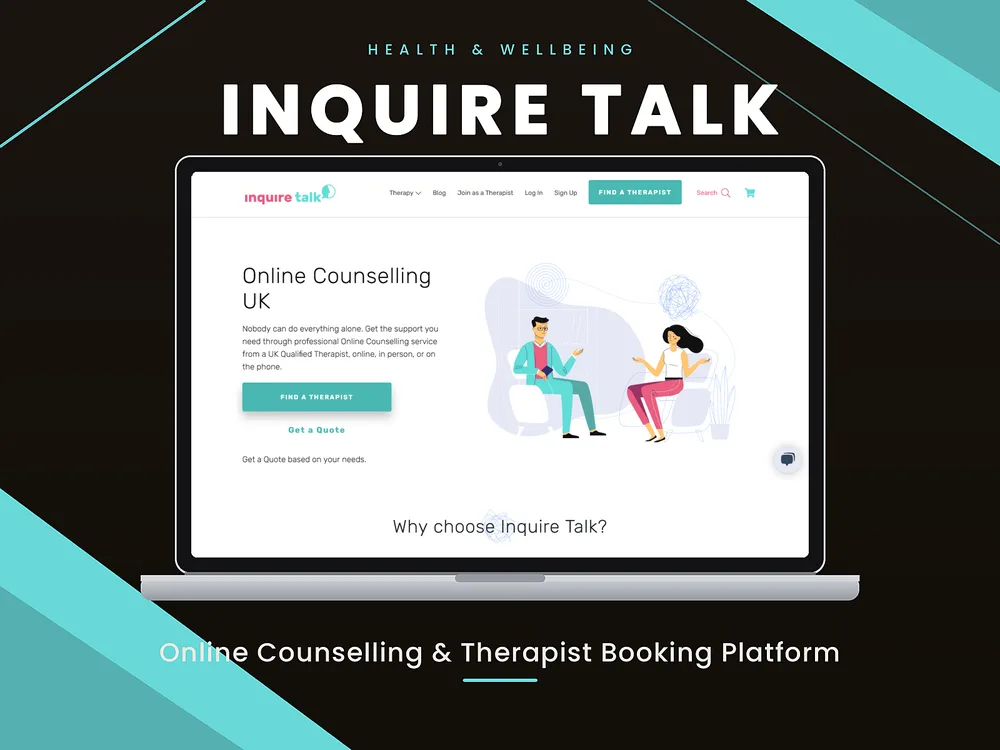

Inquire Talk is a UK-based online counselling platform connecting people with licensed therapists for support with anxiety, depression, relationship issues, grief, and a range of other concerns. The service is built around choice — clients can meet with a therapist in person, over Skype, by phone, through secure video, or via text chat, depending on what feels right for them.
The client came to me with a completed set of Figma designs and a clear goal: turn those designs into a working marketplace where therapists could list their services and patients could find, book, and pay for sessions without friction. What I delivered was a fully custom WordPress theme built on top of a heavily modified Dokan marketplace, complete with search and filtering, booking, messaging, and live video consultations.
Key Information:
| CMS Used | WordPress | ||||||
| Category | Multi-vendor Marketplace | ||||||
| Ecommerce Platform | WooCommerce | ||||||
| Server setup | OpenLitespeed on DigitalOcean cloud server | ||||||
| Theme | Custom theme, developed from scratch | ||||||
| Experiences | Responsive, Speed Optimized, Retina Ready | ||||||
| Features Included |
|
||||||
| Plugin Integrations |
|
||||||
| Service Integrations |
|
||||||
| Security |
|
||||||
| Payment Gateways |
|
||||||
| Optimizations |
|
||||||
| Skills |
|
||||||
| Rated by Client |
Project Overview
At its core, Inquire Talk is a two-sided marketplace. On one side are therapists — counsellors, psychotherapists, and specialists across dozens of disciplines — who create profiles, list their qualifications, set their rates, and manage their own availability. On the other side are people looking for support, who need a way to find a therapist that fits their situation, whether that’s based on the type of therapy, the issue they’re facing, or how they’d prefer to talk to someone.
The platform exists to remove the usual friction of finding a therapist: browsing directories, cold-emailing practices, waiting for callbacks. Instead, a visitor can filter by specialty, session type, price, and even the language a therapist speaks, land on a profile that lists certifications and experience, and book a session directly. Once a booking is made, the platform also becomes the space where the actual therapy relationship happens, through messaging, video calls, or phone consultations arranged inside the account.
Users can register as either a therapist or a client, browse and compare providers, book paid or trial sessions, message their therapist directly, and manage ongoing appointments, all without leaving the site.
The Challenge
The brief carried a few problems that don’t come up on a typical business website.
The first was building a marketplace, not a brochure site. Therapists needed their own onboarding flow, their own dashboards, and a way to manage bookings and availability independently, while the platform itself still needed to feel like one cohesive product rather than a patchwork of vendor pages.
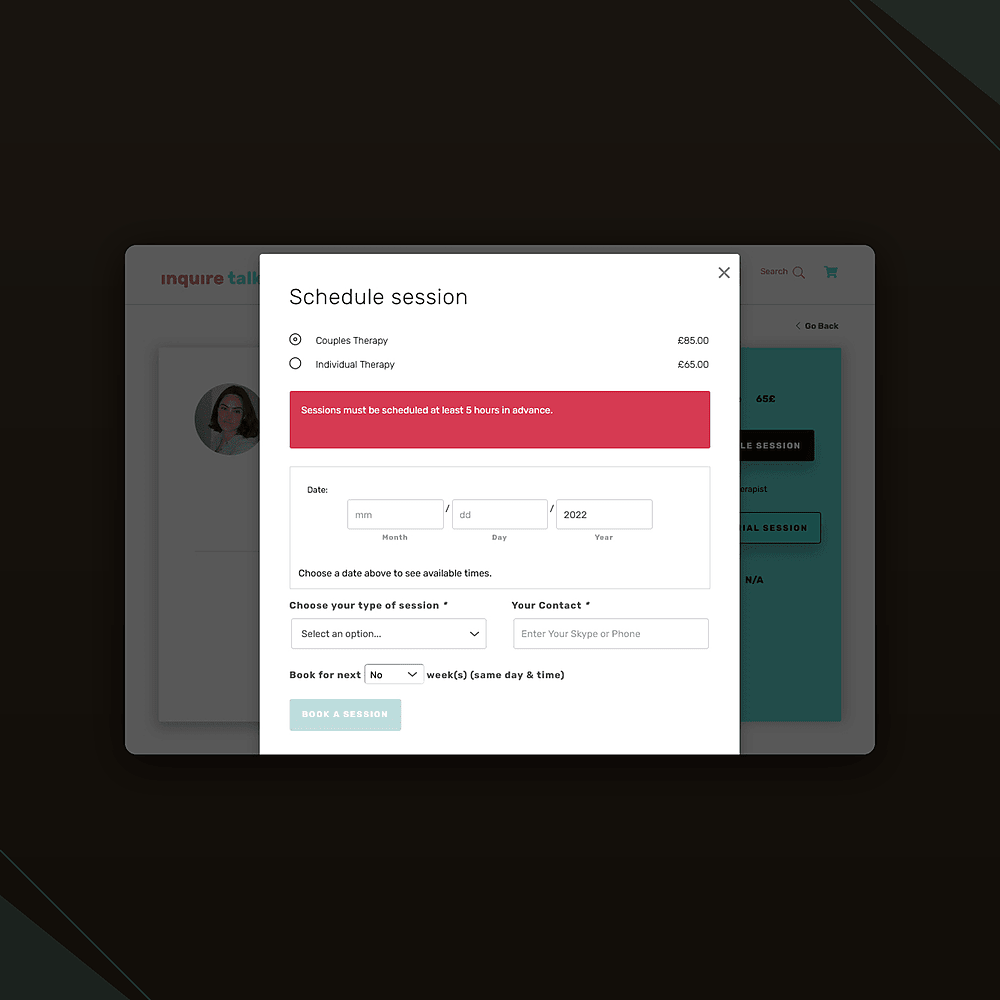
The second was appointment logistics. A booking system for therapy sessions isn’t the same as booking a table at a restaurant. Sessions needed a minimum lead time, different pricing for different session types (individual versus couples therapy, for example), and a way to handle recurring bookings for clients who wanted to see the same therapist weekly.
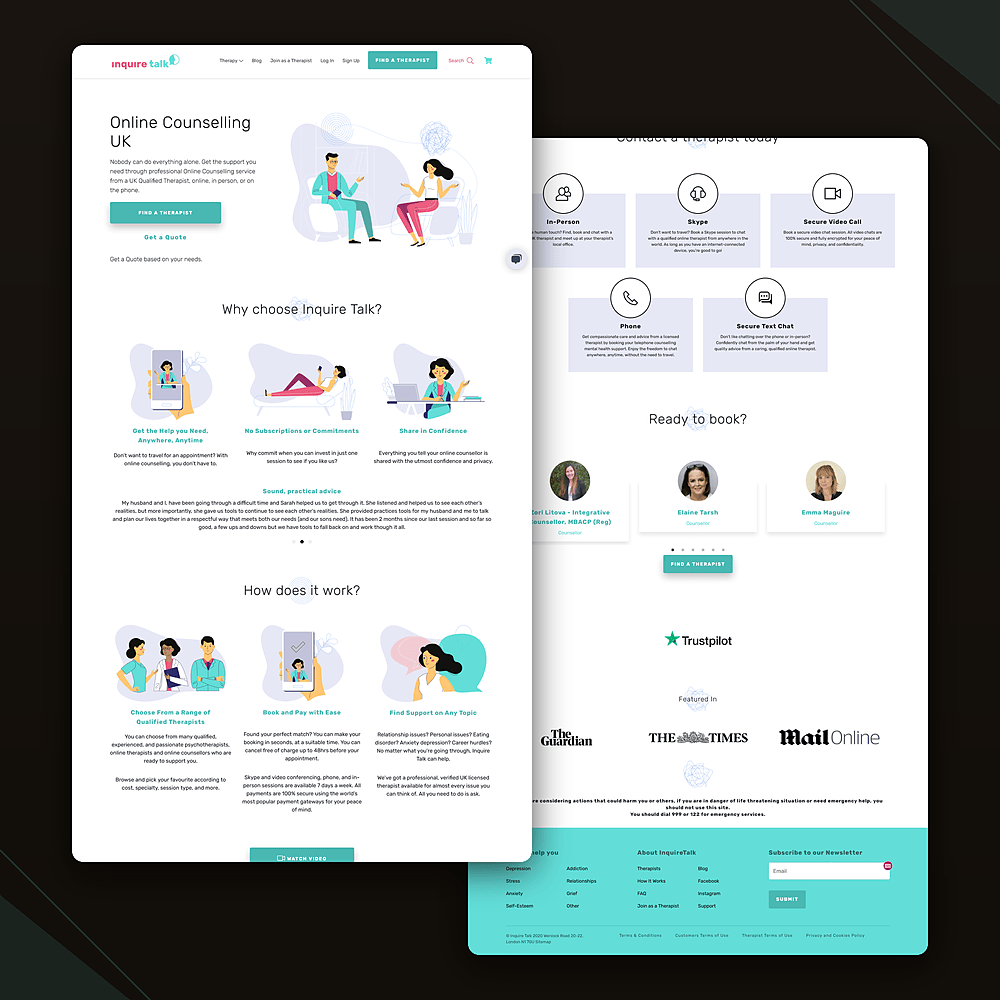
The third was consultation flexibility. Inquire Talk offers five distinct ways to meet a therapist: in person, Skype, phone, secure video, and text chat. Each of those needed to work inside the same booking and payment flow without confusing the user about what they were actually signing up for.
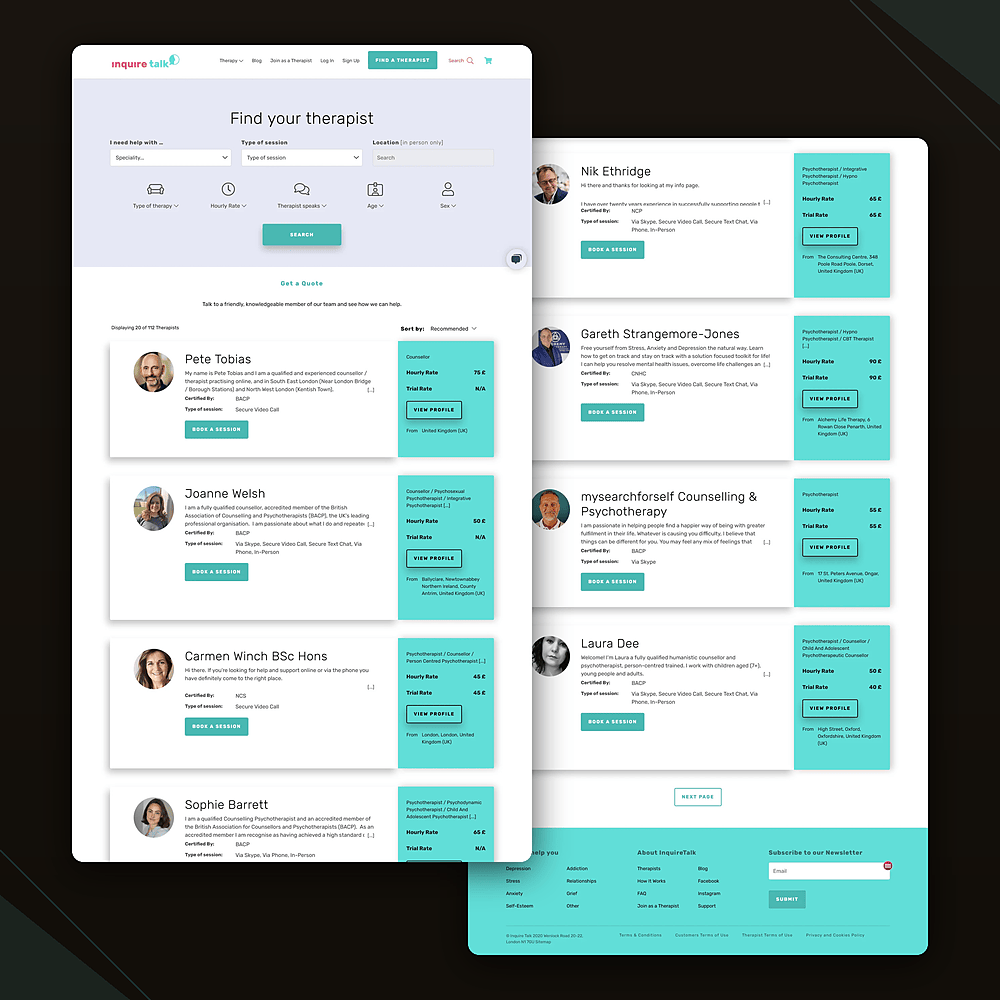
The fourth was discovery. With dozens of therapists on the platform, each with different specialties, certifications, and rates, a simple list wasn’t going to cut it. Visitors needed to narrow the field quickly using the criteria that actually mattered to them: type of therapy, hourly rate, language, age group served, and gender of the therapist.
None of this comes solved out of the box with a standard WordPress marketplace plugin. It had to be built.
Design & Development
The client supplied final Figma designs, so the development side of the project was about converting static screens into a working, maintainable theme, not making design decisions from scratch.
I built the front end as a completely custom WordPress theme rather than adapting an existing template. Starting from a blank theme gave more control over markup, page speed, and how closely the final build could match the Figma files, without inheriting the extra weight that comes with pre-built marketplace themes.
A dynamic theme settings panel was built into the WordPress admin so the client could update homepage sections, testimonials, and featured-in logos without touching code. Sections like “Why Choose Inquire Talk,” “How Does It Work,” and the therapist carousel on the homepage are all editable from the dashboard.
Every template was built responsive from the start, tested across breakpoints rather than retrofitted afterward, and built retina-ready so imagery and icons stay sharp on higher-density screens. On the UX side, the layout was kept deliberately calm: soft colours, generous white space, simple iconography. That matters more on a mental health platform than it would on a typical business site. Visitors browsing therapist profiles or filling out a search form needed the interface to feel unhurried, not transactional.
Marketplace Functionality
Dokan handles the vendor infrastructure — registration, commissions, individual storefronts — but very little of it was used as-is. Therapists aren’t selling products, they’re selling their time and expertise, so most of the default marketplace assumptions had to be rebuilt around that.
The vendor onboarding flow was reworked so a therapist signing up provides the information that actually matters here: certifications, specialties, therapy types offered, languages spoken, and the age groups they work with. Standard Dokan vendor fields, built around product listings, weren’t a fit for that.
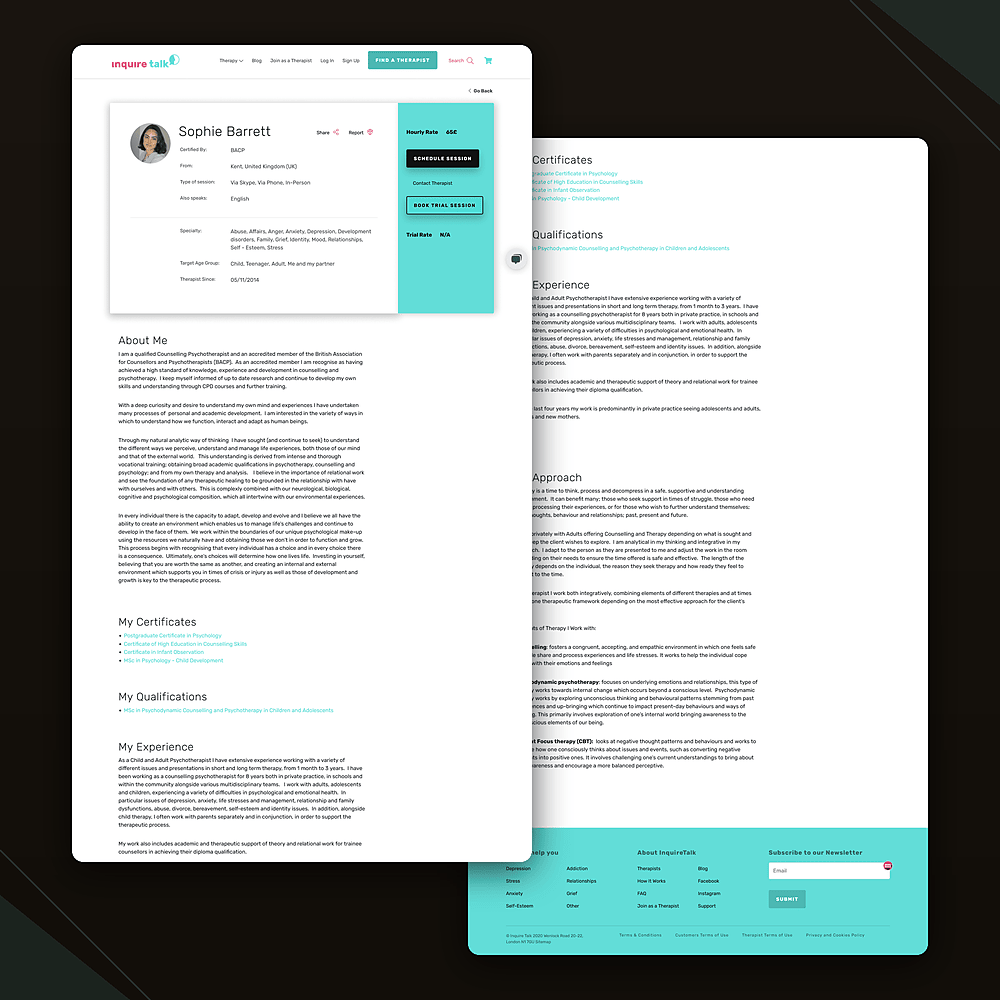
Therapist profile pages were rebuilt from the ground up. Instead of a typical vendor storefront, each profile reads more like a professional bio: qualifications, certifying body, years of experience, approach to therapy, and available consultation methods, alongside the booking action itself.
The Dokan dashboard was redesigned so therapists manage their practice rather than a shop. That means availability, session types and pricing, and incoming bookings, without the product-catalogue framing Dokan ships with by default.
These changes were necessary because Dokan, out of the box, is built for people selling physical or digital goods. Therapy is a service built on trust and credentials, and the marketplace needed to communicate that on every page a client sees.
Advanced Features
Search was one of the more involved pieces of the build. Rather than a single keyword field, the therapist search lets visitors filter by specialty, type of therapy, consultation method, hourly rate, therapist gender, language, and location for in-person sessions. Someone looking specifically for a CBT therapist who offers video sessions in a certain price range can narrow the entire directory down to a handful of relevant profiles in seconds, which matters when the alternative is scrolling through dozens of bios.
Booking runs on WooCommerce Bookings, customized to handle the specifics of therapy appointments: a minimum lead time before a session can be scheduled, different rates for different session types like individual or couples therapy, and the option to book the same time slot for several weeks running for clients who want ongoing sessions with one therapist.
Once a session is booked, AtomChat powers the ongoing communication between therapist and client, one-to-one messaging plus audio and video calls, so the relationship can continue inside the platform rather than requiring a jump to a third-party app. A live chat widget is also available site-wide for pre-booking questions.
A support desk gives clients and therapists a direct channel for account or booking issues, and Google Analytics tracking gives the client visibility into how visitors move through the search and booking flow.
Each of these pieces solves a specific problem in the client journey: finding the right therapist, booking with confidence, and then actually having the session, all without leaving the site.
Performance & Optimization
Building the theme from scratch rather than starting with a pre-packaged template meant there was no unused CSS, unnecessary scripts, or bloated framework to strip out later. Every asset loaded on a page is there because a template calls for it.
The site runs on OpenLiteSpeed hosted on DigitalOcean, a combination chosen for its handling of concurrent requests and its compatibility with LiteSpeed’s caching layer, which matters on a marketplace with a lot of dynamic, per-user content like dashboards and messaging.
Cloudflare sits in front of the site for caching and DDoS protection, and Wordfence handles application-level security alongside server-side firewall rules and general WordPress hardening: locking down file editing, login attempts, and known vulnerability patterns. Given that the platform handles personal information related to mental health, that layer of security wasn’t optional.
On testing, the site scored 90+ on Google PageSpeed, 85%+ on GTmetrix, and 95%+ on Pingdom. Those numbers reflect a front end that was kept lean from the first line of code, rather than optimized after the fact.
Technology Stack
The platform is built on WordPress with WooCommerce and Dokan handling e-commerce and marketplace logic, and WooCommerce Bookings managing appointment scheduling. The front end is a custom theme written in PHP, HTML5, CSS3, and JavaScript/jQuery, built specifically for this project rather than adapted from a theme framework. AtomChat handles messaging and video consultations, Google reCAPTCHA protects forms from spam, and Google Analytics tracks site usage. This combination was chosen because it gave full control over the marketplace logic and user experience while staying on a platform the client can manage long-term without needing a developer for every content change.
Project Outcome
The finished platform gives Inquire Talk a working marketplace where therapists can list their services and manage their own practice, and where clients can search, compare, and book sessions across five different consultation formats. What started as a set of Figma files is now a live product with its own booking system, messaging, video consultations, and admin tools the client can run day to day.
The client was happy with the final result and the collaborative process throughout the build.
Client review for this project
Wonderful job done with developing our wp marketplace website. Pretty fast, knows what he is doing, very helpful and supportive. Beside that he is very responsive and easy to talk. Would recommend.