
I-Surgical – WordPress & WooCommerce Multi-Vendor Marketplace
I-Surgical is a Namibian medical supplier based in Windhoek, stocking surgical instruments, laboratory apparatus, hospital equipment and clinical consumables for healthcare providers across the region. Their customers are hospitals, dental and veterinary clinics, laboratories and emergency care facilities — buyers who order in volume and expect accuracy.
The brief was to move that catalogue online. I-Surgical needed a store that could hold thousands of products, keep pricing behind a login for account holders, and stay quick to browse for procurement teams working from any device.
Key Information:
| CMS Used | WordPress | ||||||
| Category | Multi-vendor Marketplace | ||||||
| Ecommerce Platform | WooCommerce | ||||||
| Server setup | Apache server with PHP and MySQL | ||||||
| Theme | Carefully chosen Premium theme | ||||||
| Experiences | Responsive, Speed Optimized, Retina Ready | ||||||
| Features Included |
|
||||||
| Plugin Integrations |
|
||||||
| Service Integrations |
|
||||||
| Security |
|
||||||
| Payment Gateways |
|
||||||
| Optimizations |
|
||||||
| Skills |
|
||||||
| Rated by Client |
Project Overview
I-Surgical sits between international manufacturers and the healthcare facilities that rely on them. The business sources everything from insulin syringes and sutures to anaesthesia machines, incubators and hospital furniture, then supplies it to professional buyers who need dependable stock and clear product information.
A website for a business like this isn't a shop window. It's the reference catalogue a purchasing officer opens when they need to confirm a specification, check availability, or place a repeat order. So the site had to do two jobs at once: present a very large inventory in a way that's easy to navigate, and function as the ordering channel for registered account holders. Everything in the build was shaped around those two responsibilities.
Business Goals
The first goal was legibility at scale. A catalogue this size only works if a buyer can get from the homepage to a specific consumable in a few clear steps, so the structure needed to carry the weight of thousands of items without ever feeling heavy.
The second was to make the site work as a genuine ordering tool for the people I-Surgical actually sells to. Because pricing is negotiated and account-specific in this trade, prices had to stay hidden until a customer logged in — protecting commercial terms while still letting anyone browse the full range.
Underneath both goals was a practical requirement: the client needed to run this catalogue themselves. Adding products, organising suppliers and publishing content all had to be straightforward for a non-technical team, so the store could grow without a developer on standby.
Challenges
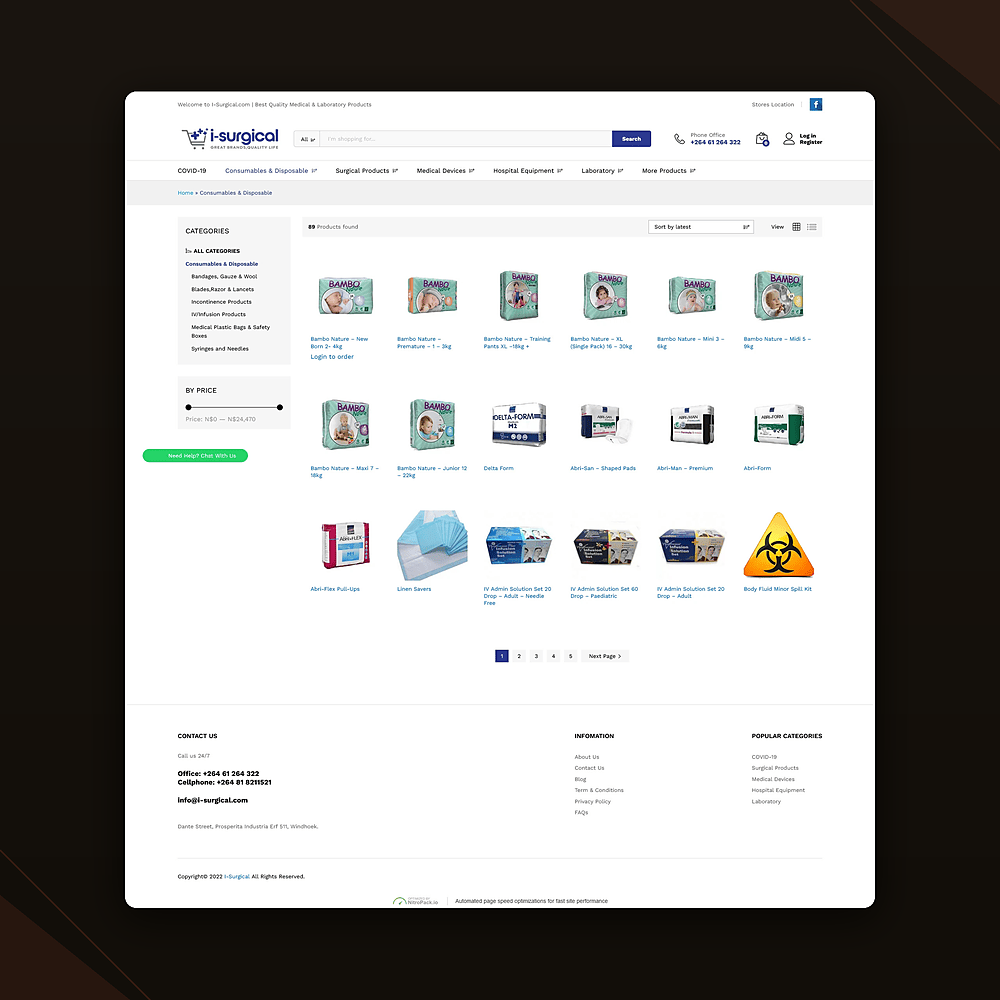
The defining challenge was volume. A single category on the site returns close to ninety products, and the full catalogue runs to thousands of SKUs. Managing that much inventory — and serving it quickly — puts real pressure on both the storefront and the admin experience behind it.
Performance was tied directly to that volume. Healthcare buyers browse from hospital networks, mobile connections and sometimes slower regional infrastructure, so pages loaded with product imagery had to stay fast regardless of where the request came from.
Product discovery was the next hurdle. With this many items, a buyer who can't quickly narrow the field will give up. The catalogue needed layered categories, filtering and search that could take someone from a broad department down to an exact product without friction.
Then there was the pricing model. Showing prices publicly wasn't an option, but hiding the catalogue entirely would have removed the store's value as a reference. The solution had to keep every product visible while gating the commercial detail behind an account.
Finally, the internal supply side needed structure. I-Surgical works with multiple suppliers, and managing all of that stock as one undifferentiated list would have made maintenance painful over time.
Design & Development
Planning came before anything visual. Mapping the catalogue into a hierarchy — departments, categories and sub-categories — was the foundation the rest of the build sat on, because getting the taxonomy right is what keeps a large store usable years later.
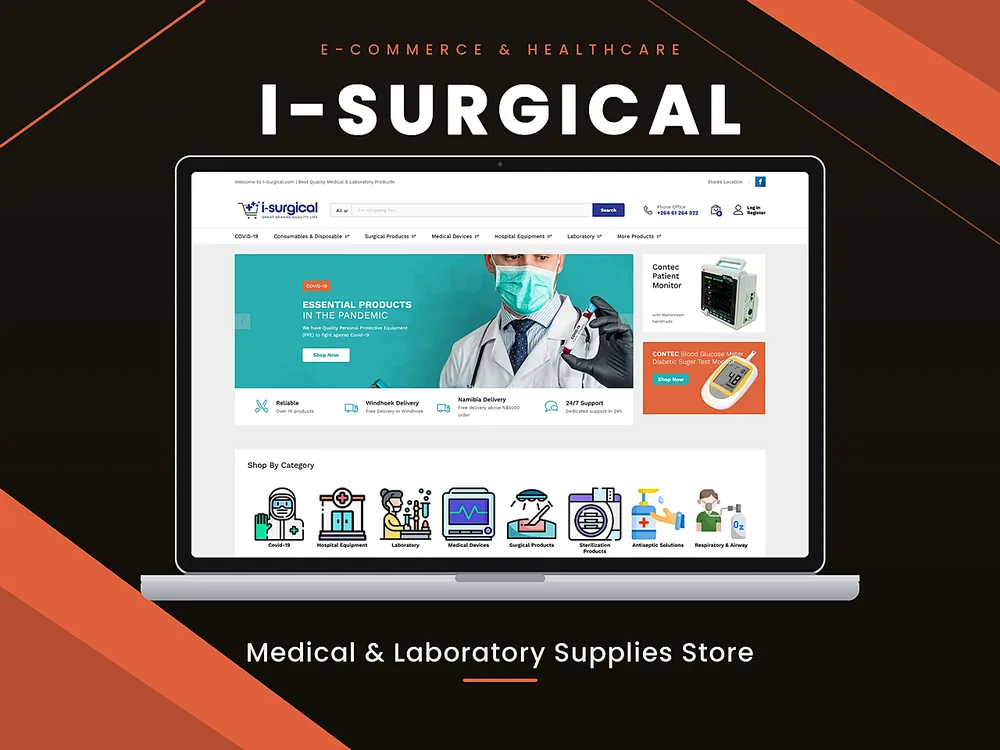

For the storefront, we selected and customised a premium WordPress theme rather than building blind. The theme gave us a tested commerce foundation; the customisation is what made it I-Surgical's. The header leads with a category-scoped search bar and a mega-menu that exposes the department structure at a glance, so buyers can either hunt or browse depending on how they think.
WooCommerce handles the commerce layer. It's the natural choice here because it manages a large product catalogue, stock status and account-based purchasing while remaining fully editable by the client. We used it to drive the "Login to order" behaviour that hides pricing from anonymous visitors — the mechanism that satisfies the account-specific pricing requirement without hiding the products themselves.
To organise the supply side, we implemented Dokan as a multi-vendor layer. Rather than exposing a public seller marketplace, it's used internally to separate I-Surgical's suppliers into their own manageable stores. That keeps product ownership tidy behind the scenes and makes adding or updating a supplier's range a contained task instead of a catalogue-wide one.
ACF Pro sits underneath the content, giving the client structured, predictable fields for the information that repeats across products and pages. It's an unglamorous decision that pays off every time someone on the team adds a product — the data goes in the right place, the same way, every time.
The whole build was developed responsively, because a purchasing officer might check a specification on a phone in a storeroom and place the order later from a desktop. The layout adapts so neither experience feels compromised.
Product Experience
The catalogue is the heart of the site, and it's built to be worked through rather than just looked at. Category pages combine a persistent sidebar of departments, a price filter and grid or list views, alongside sorting and pagination — the controls a buyer expects when they're scanning dozens of similar items and need to bring order to the list.
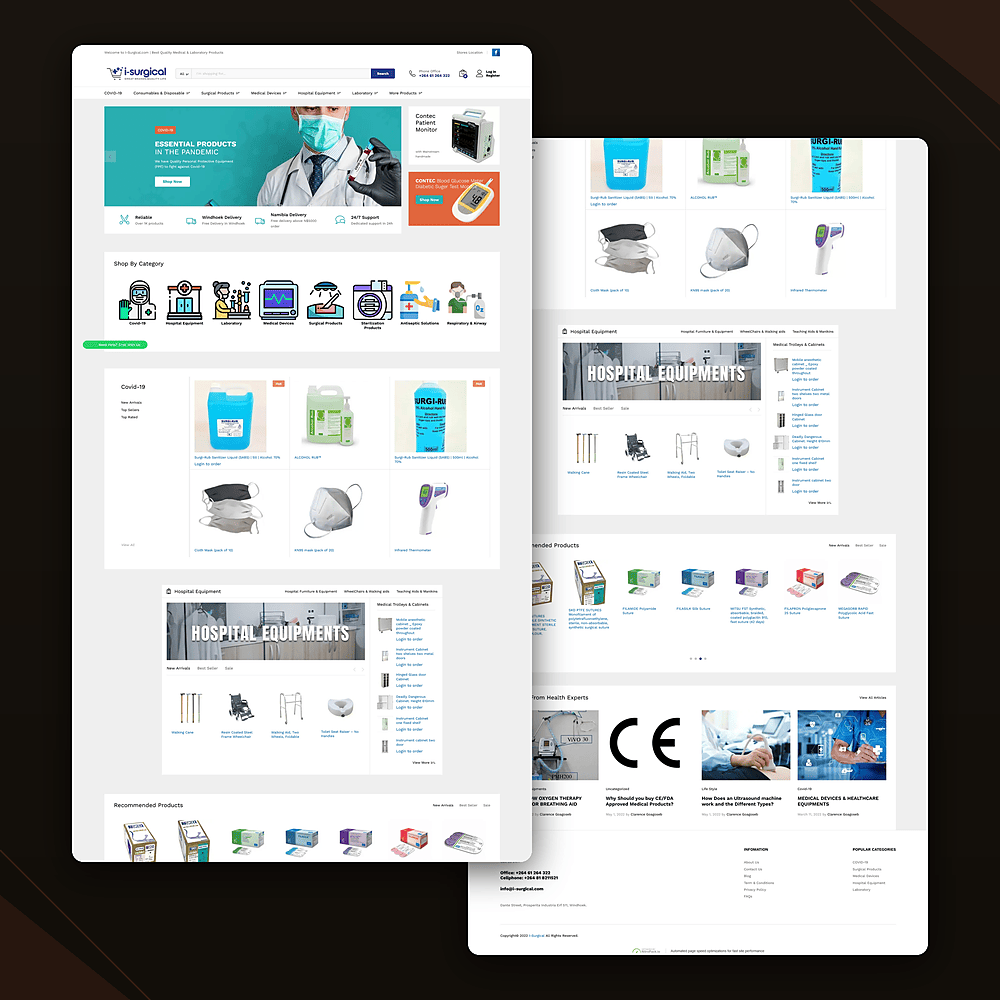
The homepage does the discovery work. A "Shop By Category" row of icons opens the main departments, while curated blocks surface specific ranges — COVID-19 supplies, hospital equipment, recommended products — so returning buyers land near what they need instead of starting from zero each visit.
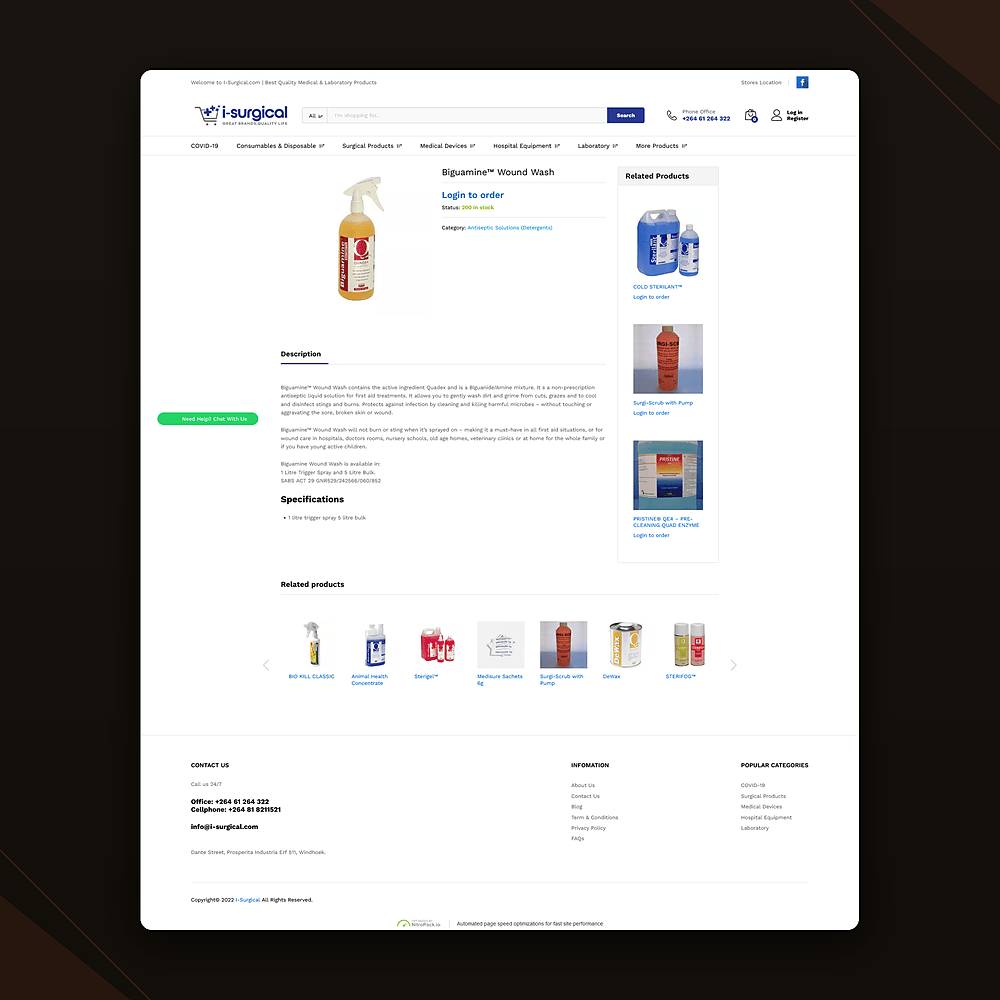
Individual product pages are deliberately clear: a large product image, stock status, a description-and-specifications tab, and a strip of related products for cross-referencing. For a buyer confirming that an item matches a clinical requirement, that combination of specification detail and visible stock status is what turns a browse into an order.
Search runs across the whole catalogue with an option to scope by category, which matters when your inventory is this broad. It lets someone who knows exactly what they want skip the hierarchy entirely.
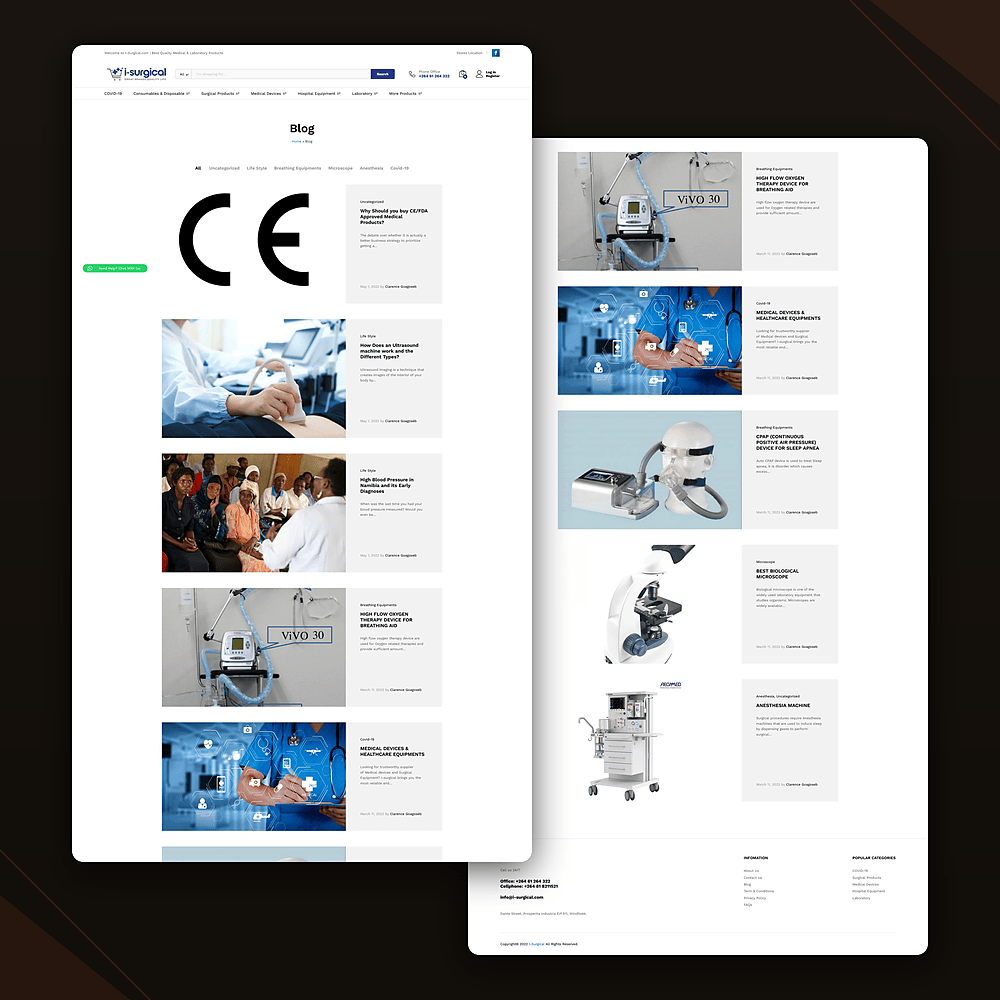
The blog extends the site beyond transactions. Organised into topics like breathing equipment, microscopes and anaesthesia, it answers the practical questions buyers ask — why to choose CE/FDA-approved products, how a piece of equipment actually works — and gives the catalogue supporting context that a bare product list can't.
A persistent "Need Help? Chat With Us" prompt keeps support one click away throughout, which reflects how this kind of purchasing works: buyers often have a question before they commit, and answering it quickly keeps the order moving.
Key Features
These pieces are designed to reinforce one another rather than stand alone. Account-based pricing gives I-Surgical control over commercial terms; the WooCommerce catalogue makes that control invisible to the buyer, who simply sees "Login to order" and knows what to do next. The Dokan vendor structure keeps thousands of products organised by supplier behind the scenes, which is what makes the front-end catalogue feel calm despite its size.
The blog and the integrated support chat work together to remove hesitation — one educates, the other answers in the moment. And with Google Analytics in place, the client can see which categories and articles buyers actually engage with, turning everyday browsing into information they can act on when deciding what to stock and promote. Individually these are ordinary features; arranged this way they let a small team run a large, professional store.
Performance & Optimization
The site runs on a conventional Apache, PHP and MySQL stack — a well-understood foundation that's dependable for a WooCommerce store of this scale and easy to host and maintain anywhere. PHP handles the application logic, MySQL the catalogue data, and Apache serves it, with the whole chain tuned so that image-heavy category pages don't drag.
Optimisation focused on the pages that carry the most weight: caching, asset handling and image delivery so that a category returning close to ninety products still loads quickly. That work was validated against the usual benchmarks — Google PageSpeed scores of 90+, GTmetrix around 85%+ and Pingdom around 95%+ — which reflect a store that stays responsive for buyers regardless of their connection.
Security
For a store that manages accounts and orders, trust is part of the product. An SSL certificate encrypts every connection so account credentials and order details stay private in transit. Cloudflare sits in front of the site, filtering malicious traffic and adding a layer of protection against attacks that target commerce platforms. A server-level firewall guards the infrastructure itself, and WordPress hardening closes the common doors that automated attacks probe for. Together these measures protect both the client's business and the healthcare buyers who rely on it.
Technology Stack
The stack was chosen for durability rather than novelty. WordPress and WooCommerce give the client a catalogue and store they can operate without technical help; Dokan brings order to a multi-supplier inventory; ACF Pro keeps product data structured and consistent; and an Apache/PHP/MySQL server provides a stable, portable home for all of it. Every choice favours something the client can maintain and grow over years, which is the right priority for a catalogue that will only get larger.
Outcome
The result is a working reference catalogue and ordering channel for a supplier with thousands of products. It presents that inventory clearly, keeps pricing behind a login for account holders, loads quickly for buyers on any device, and organises a multi-supplier back end into something a small team can manage day to day. Built on a stable, well-supported stack and delivered in roughly ten days of development followed by five days of testing, refinement and content population, it's a store designed to scale with the business rather than one it will outgrow.
Client review for this project
Amazing work. Great communication and we worked together on this big project, Very Satisfied